Saturday, June 29, 2013

ITC judge rules against InterDigital in first round of 3G patent case

After two long years, the International Trade Commission has finally come to a decision in favor of Huawei, Nokia and ZTE in a 3G patent case brought by InterDigital in 2011. According to an ITC judge, the three phone manufacturers did not violate the seven InterDigital-owned patents that covers various WCDMA and CDMA2000 technologies used to make their devices. InterDigital even went so far as to request the ban of US sales of these devices pending a decision. The Pennsylvania-based company filed a similar complaint against LG, which chose a settlement instead of going through the courts. Still, this is just a preliminary ruling; the final decision of the case is expected in October.

Comments

Source: Reuters

Source: http://www.engadget.com/2013/06/28/itc-judge-rules-against-interdigital-in-first-round-of-3g-patent/?utm_medium=feed&utm_source=Feed_Classic&utm_campaign=Engadget

2013 srt viper scott walker recall fisker atlantic social darwinism wisconsin recall election april 4 wisconsin primary

Federer's conqueror loses in 3rd-round letdown

Sergiy Stakhovsky of Ukraine plays a return to Jurgen Melzer of Austria during their Men's second round singles match at the All England Lawn Tennis Championships in Wimbledon, London, Friday, June 28, 2013. (AP Photo/Sang Tan)

Sergiy Stakhovsky of Ukraine plays a return to Jurgen Melzer of Austria during their Men's second round singles match at the All England Lawn Tennis Championships in Wimbledon, London, Friday, June 28, 2013. (AP Photo/Sang Tan)

Andy Murray of Britain returns to Tommy Robredo of Spain during their Men's singles match at the All England Lawn Tennis Championships in Wimbledon, London, Friday, June 28, 2013. (AP Photo/Anja Niedringhaus)

Andy Murray of Britain reacts after defeating Tommy Robredo of Spain during their Men's singles match at the All England Lawn Tennis Championships in Wimbledon, London, Friday, June 28, 2013. (AP Photo/Anja Niedringhaus)

Kaia Kanepi of Estonia reacts as she defeats Angelique Kerber of Germany in a Women's second round singles match at the All England Lawn Tennis Championships in Wimbledon, London, Friday, June 28, 2013. (AP Photo/Alastair Grant)

Angelique Kerber of Germany fails to play a return to Kaia Kanepi of Estonia in their Women's second round singles match at the All England Lawn Tennis Championships in Wimbledon, London, Friday, June 28, 2013. (AP Photo/Sang Tan)

(AP) ? The player who stunned Roger Federer in one of Wimbledon's greatest upsets didn't stick around very long.

Two days after eliminating the seven-time champion on Centre Court, Sergiy Stakhovsky fell to Jurgen Melzer in four sets Friday in the third round at the All England Club.

The 116th-ranked Ukrainian couldn't replicate the serve-and-volley magic that stifled Federer, losing 6-2, 2-6, 7-5, 6-3 to the left-handed Austrian. While Federer struggled with Stakhovsky's serve, Melzer broke him six times.

"I'm just a little disappointed that I got so blinded by the game I produced with Roger that I kept going with the same game I played against Jurgen, which was just not right," Stakhovsky said.

Stakhovsky, who called for the trainer and had his right ankle taped in the first set, kept coming to the net even though Melzer was zeroing in on his serve.

"I think I just played stupid," the Ukrainian said.

Doing everything right so far has been second-seeded Andy Murray, who trounced Tommy Robredo 6-2, 6-4, 7-5 under the Centre Court roof to cruise into the fourth round. The U.S. Open champion hasn't dropped a set this week in his bid to become the first British player to win the men's trophy in 77 years.

"I played my best match of the tournament so far," said Murray, who no longer has Federer or Rafael Nadal in his half of the draw and remains on course to meet No. 1 Novak Djokovic in the final.

Advancing to the third round were fourth-seeded David Ferrer and No. 13 Tommy Haas. No. 15 Nicolas Almagro was knocked out by Poland's Jerzy Janowicz in a third-round match.

Among the women, No. 7 Angelique Kerber was ousted in three sets in second-round play by Estonia's Kaia Kanepi. Kerber became the sixth player among the top-10 seeded women to go out.

With four of the top 10 men also gone after the second round, it equals the worst performance by the top 10 at any Grand Slam in the 45-year history of the Open era.

For the second straight day, play was disrupted by rain and the sliding roof was closed over Centre Court. Four men's singles matches didn't start and were rescheduled for Saturday, while three women's singles matches were suspended by darkness.

Among the uncompleted matches, 2011 champion and eighth-seeded Petra Kvitova was down a break in the third set to Ekaterina Makarova, 3-6, 6-2, 2-1.

In a tournament jolted by a rash of injuries and upsets, the player who caused the biggest surprise of them all came crashing back to earth.

Stakhovsky had snapped Federer's streak of reaching 36 Grand Slam quarterfinals on Wednesday, beating perhaps the game's greatest all-time player on the biggest stage in the sport.

On Friday, he was out on Court 3 and couldn't maintain his level of play against Melzer, a 32-year-old all-court player who has reached at least the fourth round of every Grand Slam.

Still, Stakhovsky will always have that momentous victory to hold onto.

"Nobody is going to take it away from me," he said. "If someone would ask me, 'Would you rather beat Roger and lose in next round?' I would always take it, obviously."

Stakhovsky said he struggled to cope with all the distractions and media interviews that came his way after the Federer match.

"It was quite hard for me because yesterday was a busy day," he said. "Everybody wanted to chat. Everybody wanted a piece. It just takes some time and energy off."

Melzer said he didn't care about the pressures on Stakhovsky and just came into the match ready to beat him with his serve returns.

"You go out there and show him that I'm not Roger Federer and I can return his serve and make him play tough volleys," he said. "That was my goal today."

Murray was dominant in beating the 29th-ranked Robredo. It was Murray's 14th straight match win on grass, a run that goes back to last year's London Olympics, where he beat Federer for the gold medal.

Murray lost serve only once and finished with 40 winners against 14 errors.

"I struck the ball very well from the start of the match," he said. "I had a lot of winners tonight and that was probably the most pleasing part because I did not serve very well on the first couple of matches. I hope I can keep playing better."

Murray will next face either No. 20 Mikhail Youzhny or Viktor Troicki.

In other men's play, Ferrer won an all-Spanish encounter against Roberto Bautista Agut to reach the third round for a sixth consecutive year.

Ferrer advanced with a scrappy 6-3, 3-6, 7-6 (4), 7-5 win in a match originally scheduled for Thursday but pushed back because of rain. He will next face No. 26 Alexandr Dolgopolov.

Melzer will face Janowicz, who served 30 aces and beat Almagro 7-6 (6), 6-3, 6-4 on Centre Court to reach the fourth round at a Grand Slam for the first time.

Only six men and four women ? 10 total ? among the top 10 seeds reached the third round ? tying the performance at Wimbledon in 1996 (four men, six women) and the French Open in 1998 (two men, eight women).

It's the worst performance by the top 10 women's seeds at any Slam in the Open era. The previous low was five at the 2001 French Open.

In another twist, this tournament has produced the fewest five-set matches (12) over the first two rounds at Wimbledon in the Open era. The previous record was 13 in 1981.

Britain's Laura Robson beat 117th-ranked Colombian qualifier Mariana Duque-Marino 6-4, 6-1 under the Centre Court roof to reach Wimbledon's third round for the first time.

Robson, who won the Wimbledon girls' title in 2008, has steadily climbed the rankings and has a good chance of getting into the second week.

"It's a big win for me," Robson said. "Any match on Centre Court is a big one. It was a great atmosphere out there today, and the roof being closed just makes it louder."

Among the early casualties in the men's draw was Grigor Dimitrov, one of the rising stars in tennis. He was eliminated in the second round in a five-set, rain-delayed match that lasted more than four hours over two days.

With girlfriend Maria Sharapova cheering him from the stands on Court 3, the 29th-seeded Bulgarian fell to 55th-ranked Slovenian Grega Zemlja 3-6, 7-6 (4), 3-6, 6-4, 11-9.

Zemlja hit a forehand passing shot on his sixth match point to become the first Slovenian to reach the third round at the All England Club.

Dimitrov is known as "Baby Fed" for a playing style, especially his one-handed backhand in the manner of Roger Federer's. But like Federer, Dimitrov failed to get to Round 3.

"Things happen I guess for a reason," Dimitrov said. "But it's a good learning curve for me. I'm going to step out strong for the upcoming weeks."

Associated Press

Source: http://hosted2.ap.org/APDEFAULT/347875155d53465d95cec892aeb06419/Article_2013-06-28-TEN-Wimbledon/id-be3a063e220748989c010dee37b75723

louis oosthuizen 10 year old gives birth c. difficile carmelo anthony nurse jackie nurse jackie peeps

Obama yet to have African legacy like predecessors

U.S. President Barack Obama, left, makes a toast during an official dinner with Senegalese President Macky Sall at the Presidential Palace on Thursday, June 27, 2013, in Dakar, Senegal. Obama is visiting Senegal, South Africa, and Tanzania on a week long trip. (AP Photo/Evan Vucci)

U.S. President Barack Obama, left, makes a toast during an official dinner with Senegalese President Macky Sall at the Presidential Palace on Thursday, June 27, 2013, in Dakar, Senegal. Obama is visiting Senegal, South Africa, and Tanzania on a week long trip. (AP Photo/Evan Vucci)

U.S. President Barack Obama looks out to sea through the 'Door of No Return,' at the slave house on Goree Island, in Dakar, Senegal, Thursday, June 27, 2013. Obama is calling his visit to a Senegalese island from which Africans were said to have been shipped across the Atlantic Ocean into slavery, a 'very powerful moment.' President Obama was in Dakar Thursday as part of a weeklong trip to Africa, a three-country visit aimed at overcoming disappointment on the continent over the first black U.S. president's lack of personal engagement during his first term. (AP Photo/Rebecca Blackwell)

President Barack Obama meets with a group of drummers that were playing music on his departure after taking a tour of Goree Island, Thursday, June 27, 2013, in Goree Island, Senegal. Goree Island is the site of the former slave house and embarkation point built by the Dutch in 1776, from which slaves were brought to the Americas. (AP Photo/Evan Vucci)

President Barack Obama meets with a group of drummers that were playing music on his departure after taking a tour of Goree Island, Thursday, June 27, 2013, in Goree Island, Senegal. Goree Island is the site of the former slave house and embarkation point built by the Dutch in 1776, from which slaves were brought to the Americas. (AP Photo/Evan Vucci)

U.S. President Barack Obama speaks during a joint press conference with his Senegalese counterpart Macky Sall, at the presidential palace in Dakar, Senegal, Thursday, June 27, 2013. Obama was in Dakar Thursday as part of a weeklong trip to Africa, a three-country visit aimed at overcoming disappointment on the continent over the first black U.S. president's lack of personal engagement during his first term.(AP Photo/Rebecca Blackwell)(AP Photo/Rebecca Blackwell)

(AP) ? President Barack Obama is receiving the embrace you might expect for a long-lost son on his return to his father's home continent, even as he has yet to leave a lasting policy legacy for Africa on the scale of his two predecessors.

Presidents Bill Clinton and George W. Bush passed innovative Africa initiatives while in the White House and passionately continue their development work in the region in their presidential afterlife. Obama's efforts here have not been so ambitious, despite his personal ties to the continent.

His first major tour of Africa as president is coming just now, in his fifth year, while Bush and Clinton are frequent fliers to Africa. Bush even will be in Dar es Salaam, Tanzania, next week at the same time as Obama, although they have no plans to meet. Instead, their wives plan to appear together at a summit on empowering African women organized by the George W. Bush Institute, with the former president in attendance.

Spirited crowds greeted Obama on his visit to French-speaking Senegal, Africa's westernmost country, with revelers frequently breaking into song and dance at the sight of the first African-American president. However thrilled they were to see him, many said they wish his visits weren't so rare.

"Two visits in five years, it's not enough," said Faye Mbissine, a 30-year-old nanny who took an early morning bus to come see Obama on Thursday outside the presidential palace. "We hope that he can come more."

Manougou Nbodj, a 21-year-old student, said he hopes Obama will bring American resources like jobs and health care. "If Obama can work with Macky Sall the way that George Bush worked with Africa before him, then we will be happy," he said, referring to the Senegalese president.

One of Bush's chief foreign policy successes was his aid to Africa, including AIDS relief credited with saving millions of lives and grants to reward developing countries for good governance. Bush followed on momentum on African policy that began under Clinton, who allowed several dozen sub-Saharan countries to export to the U.S. duty-free.

Obama has continued the Bush and Clinton programs during tough economic times. But his signature Africa policy thus far has been food security, through less prominent programs designed to address hunger through policy reform and private investment in agriculture.

Obama's mantra on Africa is it doesn't need handouts, but investment to spur self-sufficient economic growth. He plans to announce Friday that Senegal is joining his New Alliance for Food Security and Nutrition and will receive $134 million in investments from private companies and $47 million from the United States.

Witney Schneidman, former deputy assistant secretary of state for African affairs, said Obama's efforts are not like Bush's AIDS initiative "where you put people on a medicine to save their lives ? very, extremely important. This is more of a structural change, and I think that's going to take time."

Under Clinton and Bush "you had this major funding, major attention, major initiatives going to Africa, and then President Obama came in, and there was a sense of stall, in a way," said Jennifer Cooke, director of the Africa program at the Center for Strategic and International Studies. She said that's understandable as he grappled with wars and an economic crisis, and she gave Obama credit for working diplomatically with African governments in his first term.

But, she said, "they weren't big, splashy initiatives that got peoples' attention either in Africa or here at home, and no big money and no big ideas that really helped define what Obama was about in Africa."

That's a disappointed those who were expecting more from the first African-American president, especially after his speech during a brief stopover in Ghana his first summer in office, in which he spoke personally of his father's life in Kenya and declared "a new moment of great promise" in Africa. "I have the blood of Africa within me," Obama said.

Schneidman argued that Obama's personal connection may also have been an impediment to deeper engagement in his first term. "The whole birther movement here in the U.S. that was sort of questioning his place of birth to begin with ... I think it was a real constraint on dealing with Africa," Schneidman said.

Mwangi Kimenyi, a Kenyan who directs the Brookings Institutions' Africa Growth Initiative, said Obama may be a victim of misplaced sky-high expectations on the continent when he was first elected.

"Africans still consider Clinton their president," Kimenyi said. "If you go to Africa and mention Clinton ? I mean, he is a hero, even today. I don't think President Obama is going to approach the level of President Clinton at all, in terms of respect, in terms of what they feel, and it's partly because, as one whose family is from Africa, the expectations were rather high. I mean, they expected him to do more, to do more visits, to actually relate better with Africans, to understand the continent better."

"There is not that feeling that, you know, we have our son there," Kimenyi said. "There's probably more reference of a prodigal son than a, you know, son."

Clinton first drew extensive attention to Africa in 1998 when he made the longest trip ever by a U.S. president, with stops in six countries that had never before been visited by any occupant of the Oval Office. He's scheduled to come back this summer for what has become an annual visit, with his Clinton Foundation investing in myriad wide-ranging projects in Africa on health, agriculture and climate change.

Bush's trip this week is his third in 19 months to promote his Pink Ribbon Red Ribbon partnership to combat breast and cervical cancer in sub-Saharan Africa and Latin America. On this visit, he and his wife, Laura, plan to help renovate a cervical cancer screening and treatment clinic in Zambia before heading to Tanzania for the African First Ladies Summit advocating investment in programs for women and girls.

Obama foreign policy adviser Ben Rhodes said the president is signaling increased engagement with the current trip and hopes it will prove to be a "pivotal moment" of Africa's growth taking off.

"Frankly, Africa is a place that we had not yet been able to devote significant presidential time and attention to," Rhodes said. "And there's nothing that can make an impact more in terms of our foreign policy and our economic and security interests than the president of the United States coming and demonstrating the importance of our commitment to this region."

___

Associated Press writer Robbie Corey-Boulet contributed to this report.

___

Follow Nedra Pickler on Twitter at https://twitter.com/nedrapickler

Associated Press

Source: http://hosted2.ap.org/APDEFAULT/89ae8247abe8493fae24405546e9a1aa/Article_2013-06-28-Obama/id-6ff1f53bc3bd412caee9cedc3761d770

google drive Savannah Guthrie Daft Punk Joyce Brothers atari breakout Amys Baking Company oj simpson

Friday, June 28, 2013

Tiny nanocubes help scientists tell left from right

June 28, 2013 ? In chemical reactions, left and right can make a big difference. A "left-handed" molecule of a particular chemical composition could be an effective drug, while its mirror-image "right-handed" counterpart could be completely inactive. That's because, in biology, "left" and "right" molecular designs are crucial: Living organisms are made only from left-handed amino acids. So telling the two apart is important-but difficult.

Now, a team of scientists at the U.S. Department of Energy's Brookhaven National Laboratory and Ohio University has developed a new, simpler way to discern molecular handedness, known as chirality. They used gold-and-silver cubic nanoparticles to amplify the difference in left- and right-handed molecules' response to a particular kind of light. The study, described in the journal Nano Letters, provides the basis for a new way to probe the effects of handedness in molecular interactions with unprecedented sensitivity.

"Our discovery and methods based on this research could be extremely useful for the characterization of biomolecular interactions with drugs, probing protein folding, and in other applications where stereometric properties are important," said Oleg Gang, a researcher at Brookhaven's Center for Functional Nanomaterials and lead author on the paper. "We could use this same approach to monitor conformational changes in biomolecules under varying environmental conditions, such as temperature-and also to fabricate nano-objects that exhibit a chiral response to light, which could then be used as new kinds of nanoscale sensors."

The scientists knew that left- and right-handed chiral molecules would interact differently with "circularly polarized" light-where the direction of the electrical field rotates around the axis of the beam. This idea is similar to the way polarized sunglasses filter out reflected glare unlike ordinary lenses.

Other scientists have detected this difference, called "circular dichroism," in organic molecules' spectroscopic "fingerprints"-detailed maps of the wavelengths of light absorbed or reflected by the sample. But for most chiral biomolecules and many organic molecules, this "CD" signal is in the ultraviolet range of the electromagnetic spectrum, and the signal is often weak. The tests thus require significant amounts of material at impractically high concentrations.

The team was encouraged they might find a way to enhance the signal by recent experiments showing that coupling certain molecules with metallic nanoparticles could greatly increase their response to light (see: http://www.bnl.gov/newsroom/news.php?a=11157). Theoretical work even suggested that these so-called plasmonic particles-which induce a collective oscillation of the material's conductive electrons, leading to stronger absorption of a particular wavelength-could bump the signal into the visible light portion of the spectroscopic fingerprint, where it would be easier to measure.

The group experimented with different shapes and compositions of nanoparticles, and found that cubes with a gold center surrounded by a silver shell are not only able to show a chiral optical signal in the near-visible range, but even more striking, were effective signal amplifiers. For their test biomolecule, they used synthetic strands of DNA-a molecule they were familiar with using as "glue" for sticking nanoparticles together.

When DNA was attached to the silver-coated nanocubes, the signal was approximately 100 times stronger than it was for free DNA in the solution. That is, the cubic nanoparticles allowed the scientists to detect the optical signal from the chiral molecules (making them "visible") at 100 times lower concentrations.

"This is a very large optical amplification relative to what was previously observed," said Fang Lu, the first author on the paper.

The observed amplification of the circular dichroism signal is a consequence of the interaction between the plasmonic particles and the "exciton," or energy absorbing, electrons within the DNA-nanocube complex, the scientists explained.

"This research could serve as a promising platform for ultrasensitive sensing of chiral molecules and their transformations in synthetic, biomedical, and pharmaceutical applications," Lu said.

"In addition," said Gang, "our approach offers a way to fabricate, via self-assembly, discrete plasmonic nano-objects with a chiral optical response from structurally non-chiral nano-components. These chiral plasmonic objects could greatly enhance the design of metamaterials and nano-optics for applications in energy harvesting and optical telecommunications."

This research was conducted at the Center for Functional Nanomaterials and funded by the DOE Office of Science and by the National Science Foundation.

Source: http://feeds.sciencedaily.com/~r/sciencedaily/matter_energy/biochemistry/~3/hrpWn2kSSTU/130628102933.htm

aj jenkins shea mcclellin nfl draft 2012 whitney mercilus 2012 nfl draft picks andrew luck andrew luck

It's complicated: Lots to sort out on gay marriage

WASHINGTON (AP) ? Two landmark Supreme Court rulings that bolster gay marriage rights don't remove all barriers to same-sex unions by a long shot. Where gay couples live still will have a lot to do with how they're treated.

Some questions and answers about Wednesday's court rulings:

Q: Can you boil down these two big rulings ? 104 pages in all ? to the basics?

A: In one case, the court said legally married gay couples are entitled to the same federal benefits available to straight couples. In the other, it cleared the way for gay marriages to resume in California, where voters banned them in 2008.

Q: What type of benefits are we talking about?

A: More than you'd expect. There are more than 1,000 federal laws in which marital status matters, covering everything from income and inheritance taxes to health benefits and pensions. In states where gay marriage is legal, same-sex couples may actually be looking forward to filing their income taxes next April ? married, filing jointly.

Q. Why does it matter where a gay couple lives?

A: Even with Wednesday's ruling, where legally married gay couples live still may affect the federal benefits they can obtain, at least for now. Social Security survivor benefits, for example, depend on where a couple is living when a spouse dies. If that happens in a state that bans or does not recognize the union, it's not for sure that the surviving spouse will be entitled to the payments. Immigration law, meanwhile, only looks at where people were married, not where they live. It's complicated.

Q: What does the U.S. marriage map look like right now?

A: It's a patchwork. Same-sex marriage is legal in 12 states and the District of Columbia ? representing 18 percent of the U.S. population. When gay marriage resumes in California, the figure will jump to 30 percent. Twenty-nine other states have constitutional amendments that ban gay marriage. Six states have laws that ban it. Two states neither allow gay marriage nor ban it.

Q: How many same-sex couples in the U.S. have been legally married?

A: The numbers are squishy. The Pew Research Center estimates there have been at least 71,000 legal marriages since 2004, when Massachusetts became the first state to legalize them, but says there are almost certainly more. The Williams Institute, a UCLA-based think tank, says approximately 114,000 couples are legally married and more than 108,000 are in civil unions or registered domestic partnerships. In California alone, 18,000 same-sex couples were married during the 142-day period when gay unions were legal there in 2008.

Q: What's all this talk about DOMA?

A: DOMA is the federal Defense of Marriage Act, enacted in 1996. The court on Wednesday struck down a section of that law that defines marriage as a union between a man and a woman for purposes of federal law. That's what had denied legally married gay couples access to a host of federal benefits and programs that are available to straight couples.

Q: Why all of the focus Wednesday on California?

A: The second case that the court addressed related to a 2008 state ballot proposition that added a ban on gay marriage to the California Constitution. The court didn't rule on the merits of that ballot proposal, but it left in place a trial court's declaration that the proposition is unconstitutional. That means same-sex weddings could resume in California in about a month, although a federal appeals court there said it may continue to bar gay marriages even longer if proponents of Proposition 8 ask for a rehearing.

Q: What more could the Supreme Court have done?

A: Tons. It could have given gay Americans the same constitutional right to marry as heterosexuals. Instead, it sidestepped the looming question of whether banning gay marriage is unconstitutional.

Q: What's President Barack Obama's take on all of this?

A: He welcomed the ruling striking down part of the Defense of Marriage Act and directed Attorney General Eric Holder to make sure federal laws are in sync with the ruling. (Obama, who endorsed gay marriage last year, broke with his Republican and Democratic predecessors and declined to defend the law in court.) Already, the Defense Department says it is beginning the process to extend health care, housing and other federal benefits to the same-sex spouses of members of the military.

Q: How does the public feel about gay marriage?

A: Public support has grown dramatically in the last few years, with a majority now favoring legal marriage for gay couples. There's even broader support for extending to gay couples the same legal rights and benefits that are available to married straight couples. An Associated Press-National Constitution Center poll last fall found 63 percent favored granting gay couples the same legal benefits straight couples had. And 53 percent favored legal recognition of same-sex marriages.

Q: What happens next?

A: Supporters of gay marriage will keep pressing to legalize same-sex unions in all 50 states. That means more battles in individual states, and more visits to the Supreme Court.

___

Follow Nancy Benac on Twitter: http://www.twitter.com/nbenac

Source: http://news.yahoo.com/complicated-lots-sort-gay-marriage-204458634.html

c mitt romney mark zuckerberg mark zuckerberg maurice jones drew Yash Chopra George McGovern

Reports: Retired general target of leaks probe

FILE - In this Jan. 29, 2011 file photo, then Joint Chiefs Vice Chairman Gen. James E. Cartwright takes part in media briefing at the Pentagon in Washington. The retired Marine general is under investigation for allegedly leaking classified information about a covert cyber attack on Iran's nuclear facilities, according to media reports Thursday, June 27, 2013. (AP Photo/Pablo Martinez Monsivais)

FILE - In this Jan. 29, 2011 file photo, then Joint Chiefs Vice Chairman Gen. James E. Cartwright takes part in media briefing at the Pentagon in Washington. The retired Marine general is under investigation for allegedly leaking classified information about a covert cyber attack on Iran's nuclear facilities, according to media reports Thursday, June 27, 2013. (AP Photo/Pablo Martinez Monsivais)

(AP) ? A former vice chairman of the Joint Chiefs of Staff is under investigation for allegedly leaking classified information about a covert cyberattack on Iran's nuclear facilities, according to media reports.

Retired Marine Gen. James "Hoss" Cartwright has been told he is a target of the probe, NBC News and The Washington Post reported Thursday. A "target" is someone a prosecutor or grand jury has substantial evidence linking to a crime and who is likely to be charged.

The Justice Department referred questions to the U.S. attorney's office in Baltimore, where a spokeswoman, Marcia Murphy, declined to comment.

The investigation of the leak about the Iran cyberattack is one of a number of national security leak investigations that have been started by the Obama administration, including ones involving The Associated Press and Fox News.

In June 2012, the New York Times reported that Cartwright was a crucial player in the cyber operation called Olympic Games, started under President George W. Bush.

Bush reportedly advised President Barack Obama to preserve Olympic Games.

According to the Times, Obama ordered the cyberattacks sped up, and in 2010 an attack using a computer virus called Stuxnet temporarily disabled 1,000 centrifuges that the Iranians were using to enrich uranium.

Congressional leaders demanded a criminal probe into who leaked the information, and Obama said he had zero tolerance for such leaks. Republicans said senior administration officials had leaked the details to bolster the president's national security credentials during the 2012 campaign.

The Times said Cartwright was one of the crucial players who had to break the news to Obama and Vice President Joe Biden that Stuxnet at one point had escaped onto the Internet.

An element of the program accidentally became public in the summer of 2010 because of a programming error that allowed it to escape Iran's Natanz plant and sent it out on the Internet, the Times reported. After the worm escaped onto the Internet, top administration officials met to consider whether the program had been fatally compromised.

Obama asked if the program should continue, and after hearing the advice of top advisers, decided to proceed.

Cartwright, a four-star general, was cleared in February 2011 of misconduct involving a young aide. An anonymous accuser had claimed Cartwright acted inappropriately during a 2009 overseas trip on which the aide traveled as a military assistant. Several sources confirmed that the former aide was a young woman.

The Pentagon inspector general quickly cleared Cartwright of the most serious allegations, which involved claims that he may have had an improper physical relationship with the woman. The report did find that Cartwright mishandled an incident in which the aide, drunk and visibly upset, visited his Tbilisi, Georgia, hotel room alone and either passed out or fell asleep on a bench at the foot of his bed. Cartwright denied any impropriety and was later cleared of all wrongdoing.

Cartwright, once considered the leading candidate to become Joint Chiefs of Staff chairman, resigned from the military in August 2011.

NBC said Cartwright did not respond to request for comment and that his attorney, former Obama White House counsel Greg Craig, said he had no comment.

Associated Press

Source: http://hosted2.ap.org/APDEFAULT/386c25518f464186bf7a2ac026580ce7/Article_2013-06-27-Justice-Leak%20Probe/id-8ed0c1cac721421dad2f2d2f34457ad5

abc bradley cooper channing tatum Jennifer Aniston naomi watts Oscar Nominations 2013 Beasts of the Southern Wild

Thursday, June 27, 2013

ASTRO Chairman Michael Steinberg, M.D., FASTRO, reaffirms Society's commitment to ending self-referral

ASTRO Chairman Michael Steinberg, M.D., FASTRO, reaffirms Society's commitment to ending self-referral [ Back to EurekAlert! ] Public release date: 27-Jun-2013
[ | E-mail | Share Share ]

Contact: Michelle Kirkwood
press@astro.org
703-286-1600
American Society for Radiation Oncology

JAMA study reveals 12 to 21 percent increase in advanced radiation treatment for low-risk prostate cancer patients

Fairfax, Va., June 27, 2013 A new study, "Use of Advanced Treatment Technologies Among Men at Low Risk of Dying from Prostate Cancer," published Tuesday, June 25, 2013, in the Journal of the American Medical Association (JAMA), by Bruce L. Jacobs, MD, MPH, et. al., analyzes treatment data for 55,947 prostate cancer patients (aged 66 years or older) in the Surveillance, Epidemiology and End Results (SEER)-Medicare database from 2004 to 2009. The study found that the use of advanced treatment technologies increased from 32 percent to 44 percent among men with low-risk prostate cancer, from 36 percent to 57 percent among men with high risk of non-cancer mortality, and from 13 percent to 24 percent among men unlikely to die from prostate cancer. In discussion, Dr. Jacobs, et. al., raise several concerns about increased treatment: "aggressive direct-to-consumer marketing and incentives associated with fee-for-service payment may promote the use of advanced treatment technologies;" "more diligence is needed to reduce the potentially unnecessary treatment of men with a low risk of dying from prostate cancer;" and "more immediately, policy change may help curtail the excessive use of advanced treatment technologies among patients least likely to benefit."

Michael L. Steinberg, MD, FASTRO, chairman of the American Society for Radiation Oncology's (ASTRO) Board of Directors, states that Dr. Jacobs, et.al.'s study reaffirms the Society's commitment to closing the self-referral loophole for radiation therapy within the Ethics in Patient Referrals Act, also known as the self-referral law.

ASTRO supports the use of intensity modulated radiation therapy (IMRT) as an appropriate, effective treatment for prostate cancer patients, however, IMRT should be carefully considered along with other effective treatments and management options, including active surveillance, by patients and their doctors. Treatment decisions should not be based on the physician's potential for profit, yet we believe profit-motivated IMRT overuse is rampant due to the proliferation of urology ownership of radiation therapy centers. The abuse of this expensive technology is allowed by a loophole in the federal physician self-referral law. We agree with Dr. Jacobs et. al.'s concerns that financial incentives may be negatively impacting treatment decisions, which we believe are compounded by ownership arrangements protected under the self-referral loophole.

ASTRO expects several independent studies will be published soon demonstrating that self-referral abuse in prostate cancer treatment, particularly among older men, is leading to unnecessary treatment, higher spending and inappropriate patient care. These new reports will add to the already significant body of evidence condemning self-referral abuse. In September 2012, a New England Journal of Medicine article authored by leading health policy experts called for closing the self-referral loophole for radiation therapy and other so-called "ancillary services." In the same month, the GAO issued a scathing report on self-referral in advanced diagnostic imaging titled "Higher Use of Advance Imaging Services by Providers Who Self-Refer Costing Medicare Millions" (GAO-12-966). On November 6, 2012, Bloomberg News published an investigative report indicting self-referral by demonstrating the real-world impact on patients' lives, which received in-depth follow-up by the local newspaper, the Monterey County Herald.

Cumulatively, all of these studies demonstrate that self-referral abuse drives overutilization of expensive technologies. Recently, several bipartisan groups, including the Bipartisan Policy Center and the Simpson-Bowles Moment of Truth project, as well as President Obama in his FY 2014 budget proposal, generally have endorsed ASTRO's recommended policy change to close the self-referral loophole. ASTRO agrees and urges Congress to act this year.

"All evidence confirms that the self-referral loophole must be closed to protect every patient and to preserve the Medicare program," said Dr. Steinberg. "This loophole endangers patients and erodes their trust in us as physicians. In addition, self-referral abuse wastes our nation's already stretched financial resources."

###

ASTRO is a partner in the Alliance for Integrity in Medicare (AIM), a broad coalition of medical societies committed to ending the practice of inappropriate physician self-referral and focused on improving patient care and preserving valuable Medicare resources. In addition to ASTRO, AIM partners include the American Clinical Laboratory Association, the American College of Radiology, the American Physical Therapy Association, the American Society for Clinical Pathology, the Association for Quality Imaging, the College of American Pathologists and the Radiology Business Management Association.

ABOUT ASTRO

ASTRO is the premier radiation oncology society in the world, with more than 10,000 members who are physicians, nurses, biologist, physicists, radiation therapists, dosimetrists and other health care professionals that specialize in treating patients with radiation therapies. As the leading organization in radiation oncology, the Society is dedicated to improving patient care through professional education and training, support for clinical practice and health policy standards, advancement of science and research, and advocacy. ASTRO publishes two medical journals, International Journal of Radiation Oncology Biology Physics (http://www.redjournal.org) and Practical Radiation Oncology (http://www.practicalradonc.org); developed and maintains an extensive patient website, http://www.rtanswers.org; and created the Radiation Oncology Institute (http://www.roinstitute.org), a non-profit foundation to support research and education efforts around the world that enhance and confirm the critical role of radiation therapy in improving cancer treatment. To learn more about ASTRO, visit http://www.astro.org.


[ Back to EurekAlert! ] [ | E-mail | Share Share ]

?


AAAS and EurekAlert! are not responsible for the accuracy of news releases posted to EurekAlert! by contributing institutions or for the use of any information through the EurekAlert! system.


ASTRO Chairman Michael Steinberg, M.D., FASTRO, reaffirms Society's commitment to ending self-referral [ Back to EurekAlert! ] Public release date: 27-Jun-2013
[ | E-mail | Share Share ]

Contact: Michelle Kirkwood
press@astro.org
703-286-1600
American Society for Radiation Oncology

JAMA study reveals 12 to 21 percent increase in advanced radiation treatment for low-risk prostate cancer patients

Fairfax, Va., June 27, 2013 A new study, "Use of Advanced Treatment Technologies Among Men at Low Risk of Dying from Prostate Cancer," published Tuesday, June 25, 2013, in the Journal of the American Medical Association (JAMA), by Bruce L. Jacobs, MD, MPH, et. al., analyzes treatment data for 55,947 prostate cancer patients (aged 66 years or older) in the Surveillance, Epidemiology and End Results (SEER)-Medicare database from 2004 to 2009. The study found that the use of advanced treatment technologies increased from 32 percent to 44 percent among men with low-risk prostate cancer, from 36 percent to 57 percent among men with high risk of non-cancer mortality, and from 13 percent to 24 percent among men unlikely to die from prostate cancer. In discussion, Dr. Jacobs, et. al., raise several concerns about increased treatment: "aggressive direct-to-consumer marketing and incentives associated with fee-for-service payment may promote the use of advanced treatment technologies;" "more diligence is needed to reduce the potentially unnecessary treatment of men with a low risk of dying from prostate cancer;" and "more immediately, policy change may help curtail the excessive use of advanced treatment technologies among patients least likely to benefit."

Michael L. Steinberg, MD, FASTRO, chairman of the American Society for Radiation Oncology's (ASTRO) Board of Directors, states that Dr. Jacobs, et.al.'s study reaffirms the Society's commitment to closing the self-referral loophole for radiation therapy within the Ethics in Patient Referrals Act, also known as the self-referral law.

ASTRO supports the use of intensity modulated radiation therapy (IMRT) as an appropriate, effective treatment for prostate cancer patients, however, IMRT should be carefully considered along with other effective treatments and management options, including active surveillance, by patients and their doctors. Treatment decisions should not be based on the physician's potential for profit, yet we believe profit-motivated IMRT overuse is rampant due to the proliferation of urology ownership of radiation therapy centers. The abuse of this expensive technology is allowed by a loophole in the federal physician self-referral law. We agree with Dr. Jacobs et. al.'s concerns that financial incentives may be negatively impacting treatment decisions, which we believe are compounded by ownership arrangements protected under the self-referral loophole.

ASTRO expects several independent studies will be published soon demonstrating that self-referral abuse in prostate cancer treatment, particularly among older men, is leading to unnecessary treatment, higher spending and inappropriate patient care. These new reports will add to the already significant body of evidence condemning self-referral abuse. In September 2012, a New England Journal of Medicine article authored by leading health policy experts called for closing the self-referral loophole for radiation therapy and other so-called "ancillary services." In the same month, the GAO issued a scathing report on self-referral in advanced diagnostic imaging titled "Higher Use of Advance Imaging Services by Providers Who Self-Refer Costing Medicare Millions" (GAO-12-966). On November 6, 2012, Bloomberg News published an investigative report indicting self-referral by demonstrating the real-world impact on patients' lives, which received in-depth follow-up by the local newspaper, the Monterey County Herald.

Cumulatively, all of these studies demonstrate that self-referral abuse drives overutilization of expensive technologies. Recently, several bipartisan groups, including the Bipartisan Policy Center and the Simpson-Bowles Moment of Truth project, as well as President Obama in his FY 2014 budget proposal, generally have endorsed ASTRO's recommended policy change to close the self-referral loophole. ASTRO agrees and urges Congress to act this year.

"All evidence confirms that the self-referral loophole must be closed to protect every patient and to preserve the Medicare program," said Dr. Steinberg. "This loophole endangers patients and erodes their trust in us as physicians. In addition, self-referral abuse wastes our nation's already stretched financial resources."

###

ASTRO is a partner in the Alliance for Integrity in Medicare (AIM), a broad coalition of medical societies committed to ending the practice of inappropriate physician self-referral and focused on improving patient care and preserving valuable Medicare resources. In addition to ASTRO, AIM partners include the American Clinical Laboratory Association, the American College of Radiology, the American Physical Therapy Association, the American Society for Clinical Pathology, the Association for Quality Imaging, the College of American Pathologists and the Radiology Business Management Association.

ABOUT ASTRO

ASTRO is the premier radiation oncology society in the world, with more than 10,000 members who are physicians, nurses, biologist, physicists, radiation therapists, dosimetrists and other health care professionals that specialize in treating patients with radiation therapies. As the leading organization in radiation oncology, the Society is dedicated to improving patient care through professional education and training, support for clinical practice and health policy standards, advancement of science and research, and advocacy. ASTRO publishes two medical journals, International Journal of Radiation Oncology Biology Physics (http://www.redjournal.org) and Practical Radiation Oncology (http://www.practicalradonc.org); developed and maintains an extensive patient website, http://www.rtanswers.org; and created the Radiation Oncology Institute (http://www.roinstitute.org), a non-profit foundation to support research and education efforts around the world that enhance and confirm the critical role of radiation therapy in improving cancer treatment. To learn more about ASTRO, visit http://www.astro.org.


[ Back to EurekAlert! ] [ | E-mail | Share Share ]

?


AAAS and EurekAlert! are not responsible for the accuracy of news releases posted to EurekAlert! by contributing institutions or for the use of any information through the EurekAlert! system.


Source: http://www.eurekalert.org/pub_releases/2013-06/asfr-acm062713.php

Mac Pro Kingdom Hearts 3 Xbox 360 PlayStation 4 ign nba playoffs Chad Johnson

Reaction to court ruling on marriage provision

Reaction to the Supreme Court's decisions Wednesday in two gay marriage cases:

___

"The laws of our land are catching up to the fundamental truth that millions of Americans hold in our hearts: when all Americans are treated as equal, no matter who they are or whom they love, we are all more free." ? President Barack Obama.

___

"While I am obviously disappointed in the ruling, it is always critical that we protect our system of checks and balances. A robust national debate over marriage will continue in the public square, and it is my hope that states will define marriage as the union between one man and one woman." ? House Speaker John Boehner, R-Ohio.

___

"The Supreme Court's decision affirms that all couples, regardless of their sexual orientation, deserve the same rights and opportunities under the law that my wife and I enjoy. The Defense of Marriage Act was a discriminatory law that unfairly treated LGBT couples differently, and has rightly been relegated to the dust bin of history." ? Sen. Michael Bennet, D-Colo.

___

"We are devastated that the Supreme Court succumbed to political pressure by voting to weaken the sacred institution. They neglected our most precious children who need a mother and a father united in marriage for healthy development." ? Rev. William Owens, president of Coalition of African-American Pastors.

___

"At long last, the legal marriages of countless gay and lesbian couples will be afforded the same federal recognition and protections as any other. Today is a cornerstone for justice and equality? when our nation once again moved closer to recognizing and celebrating all LGBT Americans for their contributions to our great country." ? GLAAD spokesperson Wilson Cruz.

___

"While we are disappointed in the Supreme Court's decision to strike down part of the federal Defense of Marriage Act, the court today did not impose the sweeping nationwide redefinition of natural marriage that was sought. Time is not on the side of those seeking to create same-sex 'marriage.' As the American people are given time to experience the actual consequences of redefining marriage, the public debate and opposition to the redefinition of natural marriage will undoubtedly intensify." ? Tony Perkins, president of the Family Research Council.

____

"This is a watershed moment for equality and a clear statement from the highest court in the land that discrimination and hatred have no place in a country founded on the principles of liberty, justice and equality." ? Rick Jacobs, chair of the California-based CourageCampaign.org.

___

"At the heart of the gay marriage argument is an untruth: unions of two men or women are not the same as unions of husband and wife. The law cannot make it so, it can only require us to paint pretty pictures to cover up deep truths embedded in human nature." ? Maggie Gallagher, fellow at the American Principles Project and co-founder of the National Organization for Marriage.

___

"Today's ruling affirms what we stand for as Americans ? the guarantee that every person and every family is given equal respect under the law. It means that married same-sex couples can participate fully in federal programs that provide much-needed security for American families. ? Rep. Jerrold Nadler, D-N.Y.

___

"We are deeply saddened by today's decision to not only allow but encourage same-sex marriage in our country? a country that was founded on biblical principles. We mourn for America's future, but we are not without hope." ?Tim Wildmon, president of American Family Association.

___

"Marriage is the true foundation for strong families. Every loving, committed couple deserves the basic human right to get married, start a family, and be treated equally under the law. No politician from this day forward should try to stand in the way of this fact." ?Sen. Kirsten Gillibrand, D-N.Y.

___

"The House defended this law, which passed with a large bipartisan coalition and was signed by President Clinton, because courts should determine the constitutionality of laws, not presidents. I'm disappointed in this decision, and the marriage debate will continue in the states." ? House Majority Leader Eric Cantor, R-Va.

___

"The Supreme Court bent the arc of history once again toward justice. The court placed itself on the right side of history by discarding Section 3 of the defenseless Defense of Marriage Act and by allowing marriage equality for all families in California. The highest court in the land reaffirmed the promise inscribed into its walls: 'equal justice under law.'" ? House Democratic Leader Nancy Pelosi, D-Calif.

___

"It is a sad day when the same court that upheld Obamacare decides to reverse course on thousands of years of tradition and a strong bipartisan coalition in Congress by striking down the Defense of Marriage Act. This Supreme Court ruling marks a low point in judicial activism where unelected judges turned against traditional marriage which has been a hallmark of American society since our nation's founding." ? Steve Scalise, chairman of the Republican Study Committee.

___

"Today's rulings advance civil marriage equality, but they should also serve as a call for Christians to embrace religious marriage equality. Countless faithful Christians have lived out their lives in committed same-sex relationships, and we have seen the fruits of their fidelity in our families, our congregations and our communities. If we use this historic moment to see more clearly how their faithfulness contributes to the common good, we will better be able to walk with our LGBT sisters and brothers as an act of Christian faith." ? Rev. Gary Hall, dean of Washington National Cathedral.

___

"The court's decision does not silence the voices of Americans. Marriage? the union of husband and wife? will remain timeless, universal, and special, particularly because children need mothers and fathers." ? Austin R. Nimocks, senior counsel for the Alliance Defending Freedom.

___

"Today's decision is a step in the right direction for same-sex couples who have made legal commitments to each other... It seems almost unthinkable that such a blatantly unfair law would exist today." ? David Dinielli, deputy legal director at the Southern Poverty Law Center.

___

"I firmly believe that preserving the institution of traditional marriage is crucial to the stability of our society and serves the best interest of American families... Today's decision is certainly a setback for the traditional values that make up the backbone of our country." ? House Judiciary Chairman Bob Goodlatte, R-Va.

___

"We still have a long way to go, as far as marriage equality throughout the country, but as a military spouse it is a great day to be an American." ? Ashley Broadway, a mother of two small children and married to Lt. Col. Heather Mack, stationed at Fort Bragg, N.C.

___

"The Supreme Court got it wrong when it said that the state can tell the federal government how it must define marriage. The federal government, on behalf of those who elected them, should be able to recognize the unique value of relationships that provide children a mother and father." ? Joseph Backholm, executive director of the Family Policy Institute of Washington.

___

"The U.S. Supreme Court's decision today puts the court on the right side of history. DOMA is unjust, un-American, and out of step with the values of our country." ? Rep. Jim Moran, D-Va.

___

"Sadly, the courts have chosen to follow at a time when our nation most needs strong leaders? leaders who wish to promote strong families instead of dismantling them." ? Rev. William E. Lori, Archbishop of Baltimore.

Source: http://news.yahoo.com/reaction-court-ruling-marriage-provision-161019974.html

second degree murders bobby petrino brian dunn vin scully petrino fired george zimmerman charged big sean

Astronomers detect 3 'super-earths' in nearby star's habitable zone

Astronomers detect 3 'super-earths' in nearby star's habitable zone [ Back to EurekAlert! ] Public release date: 27-Jun-2013
[ | E-mail | Share Share ]

Contact: Ivy Kupec
ikupec@nsf.gov
703-292-8796
National Science Foundation

Discovery represents whole new era, studying earth-like planets

New observations of a star known as Gliese 667C have revealed a system with at least six planets, including a record-breaking three super-Earths orbiting in the star's "habitable zone" where liquid water could exist on the planets. This is the first planetary system found to have a fully packed habitable zone.

"The three planets in the habitable zone are roughly Earth-sized, and only about three to four times the mass of the Earth," said Steven Vogt, University of California, Santa Cruz astronomy and astrophysics professor who is on a team with Paul Butler of the Carnegie Institution of Washington's Department of Terrestrial Magnetism that made this discovery.

The same team announced last year they had already found one planet in the habitable zone of this star system. They suspected the presence of more planets but couldn't confirm them given the data set available then. This new result confirms the presence of two previously known planets orbiting this star, but also reveals five more. The National Science Foundation (NSF) funds both Vogt and Butler's research.

"Finding multiple Super-earths orbiting in the habitable zone of such a nearby star is quite significant," Vogt said. "It really confirms our suspicion that our galaxy is teeming with potentially habitable rocky planets. Many of these, such as the ones around GJ 667C, are even near enough to imagine sending robotic interstellar probes out to study within a few human lifetimes."

Also funded by NSF, coauthor Rory Barnes at the University of Washington noted the discovery offers additional insights. "The number of potentially habitable planets in our galaxy is much greater if we can expect to find several of them around each low-mass star. Instead of looking at 10 stars to look for a single potentially habitable planet, we now know we can look at just one star and have a high chance of finding several of them," he said

Gliese 667C is a well-studied star. Just over one-third the mass of the Sun, it is part of a triple-star system known as Gliese 667 (also referred to as GJ 667), 22 light-years away in the constellation Scorpius (the Scorpion). This is relatively close to Earth, within the Sun's galactic neighborhood, and much closer than the star systems investigated using telescopes such as the planet-hunting Kepler space telescope.

"This discovery is really the start of a whole new era studying Earth-like planets that may have liquid water on the surface," said Maria Womack, NSF program officer. "This is a result of more than a decade of hard work using the best tools to do cutting-edge science--just the kind of research NSF loves to be part of."

The team of astronomers--led by Guillem Anglada-Escud of the University of Gttingen, Germany, and Mikko Tuomi of the University of Hertfordshire, U.K.--combined new observations from Keck and other telescopes with extensive data collected previously by the High Accuracy Radial velocity Planet Searcher at the European Southern Observatory's 3.6-meter telescope in Chile. The findings will be published this week in the journal Astronomy and Astrophysics.

###

-NSF-


[ Back to EurekAlert! ] [ | E-mail | Share Share ]

?


AAAS and EurekAlert! are not responsible for the accuracy of news releases posted to EurekAlert! by contributing institutions or for the use of any information through the EurekAlert! system.


Astronomers detect 3 'super-earths' in nearby star's habitable zone [ Back to EurekAlert! ] Public release date: 27-Jun-2013
[ | E-mail | Share Share ]

Contact: Ivy Kupec
ikupec@nsf.gov
703-292-8796
National Science Foundation

Discovery represents whole new era, studying earth-like planets

New observations of a star known as Gliese 667C have revealed a system with at least six planets, including a record-breaking three super-Earths orbiting in the star's "habitable zone" where liquid water could exist on the planets. This is the first planetary system found to have a fully packed habitable zone.

"The three planets in the habitable zone are roughly Earth-sized, and only about three to four times the mass of the Earth," said Steven Vogt, University of California, Santa Cruz astronomy and astrophysics professor who is on a team with Paul Butler of the Carnegie Institution of Washington's Department of Terrestrial Magnetism that made this discovery.

The same team announced last year they had already found one planet in the habitable zone of this star system. They suspected the presence of more planets but couldn't confirm them given the data set available then. This new result confirms the presence of two previously known planets orbiting this star, but also reveals five more. The National Science Foundation (NSF) funds both Vogt and Butler's research.

"Finding multiple Super-earths orbiting in the habitable zone of such a nearby star is quite significant," Vogt said. "It really confirms our suspicion that our galaxy is teeming with potentially habitable rocky planets. Many of these, such as the ones around GJ 667C, are even near enough to imagine sending robotic interstellar probes out to study within a few human lifetimes."

Also funded by NSF, coauthor Rory Barnes at the University of Washington noted the discovery offers additional insights. "The number of potentially habitable planets in our galaxy is much greater if we can expect to find several of them around each low-mass star. Instead of looking at 10 stars to look for a single potentially habitable planet, we now know we can look at just one star and have a high chance of finding several of them," he said

Gliese 667C is a well-studied star. Just over one-third the mass of the Sun, it is part of a triple-star system known as Gliese 667 (also referred to as GJ 667), 22 light-years away in the constellation Scorpius (the Scorpion). This is relatively close to Earth, within the Sun's galactic neighborhood, and much closer than the star systems investigated using telescopes such as the planet-hunting Kepler space telescope.

"This discovery is really the start of a whole new era studying Earth-like planets that may have liquid water on the surface," said Maria Womack, NSF program officer. "This is a result of more than a decade of hard work using the best tools to do cutting-edge science--just the kind of research NSF loves to be part of."

The team of astronomers--led by Guillem Anglada-Escud of the University of Gttingen, Germany, and Mikko Tuomi of the University of Hertfordshire, U.K.--combined new observations from Keck and other telescopes with extensive data collected previously by the High Accuracy Radial velocity Planet Searcher at the European Southern Observatory's 3.6-meter telescope in Chile. The findings will be published this week in the journal Astronomy and Astrophysics.

###

-NSF-


[ Back to EurekAlert! ] [ | E-mail | Share Share ]

?


AAAS and EurekAlert! are not responsible for the accuracy of news releases posted to EurekAlert! by contributing institutions or for the use of any information through the EurekAlert! system.


Source: http://www.eurekalert.org/pub_releases/2013-06/nsf-adt062713.php

john scott barry sanders barry sanders jimmie johnson juan pablo montoya crash chardon high school shooting mark martin

Wednesday, June 26, 2013

Don?s Breakthrough

Jon Hamm as Don Draper.

Jon Hamm as Don Draper in Mad Men

Courtesy of Jaimie Trueblood/AMC

Slate?s Mad Men ?TV Club? writers Hanna Rosin and Seth Stevenson were on Facebook on Monday to chat with readers about the Season 6 finale. The following transcript has been edited for length and clarity.

Seth Stevenson: How did everyone feel about the final episode?

Johanna Humphrey: I don't know if it was just the music at the end (Matthew Weiner uses the closing music in very interesting ways) or that I was expecting all season for someone to die, but I feel like next season will be redemptive. The closing shot of Don coming to grips with his past might be signaling a reversal of this season, where we saw him sliding deeper and deeper into the abyss. It might not be a happy ending, but I imagine we'll see a different Don next year. (I've said this before?and was wrong.)

Hanna Rosin: I'm with you, Johanna. Anyway, how much lower can he go? The trick will be to make a clean, open Don still feel like Don. Maybe the harder trick will be to make him still interesting.

Seth Stevenson: Me three. I think viewers couldn't have taken watching Don take another spin on the wheel of suffering. It was time for some evolution. I'm OK with a sobered-up Don in Season 7. Let's have Peggy spiral out of control!

Cathy Pike Maynard: I had to watch it twice to absorb it. I thought it was one of the best-written to date. I think it's Jon Hamm's time to win an Emmy.

Hanna Rosin: What was your favorite scene?

Cathy Pike Maynard: My favorite scene was the last shot of him showing the kids where he grew up.

Hanna Rosin: I loved that scene, too. The house was over-the-top, but it was also beautiful. I really bought that scene.

Andrea Serna: I also watched it twice. I loved the closing scene. It gave me hope for Sally.

Seth Stevenson: Yes, I found myself surprisingly moved by the look that Sally and Don exchanged. You could sense their relationship becoming stronger as it overcomes Don's mistakes. And Sally might have realized some of the privileges she takes for granted.

Monica Chiaramonte: I think with this final scene all the flashbacks during the season (hated by so many, not by me though) made sense and made this last scene even more powerful.

Sam Perez: SPOILER ALERT! The scene right after Don receives his forced hiatus, we see Peggy in an office. She sits with her back to the camera but facing the windows. Was I the only one who thought we were about to get a flash of Don falling to his doom?

Hanna Rosin: Brilliant! Morbid! It didn't cross my mind, but maybe that's what was being hinted at.

Scott Brannon: Yeah, I was waiting for that to happen as well. Scary.

Seth Stevenson: Now that would have spurred some water-cooler talk! I did feel Peggy's commandeering Don's desk chair?suddenly wearing pants, no less?was a bit heavy handed. I half expected her to find Don's wingtips under the desk and slip them on.

Hanna Rosin: You are all leading me to believe that Peggy will carry next season?Peggy as Don, icy cool, brilliant, hiding secrets of her own. Very ?end of men.?

Seth Stevenson: Yes! I vote for a Season 7 with a reformed, optimistic Don and a Peggy who is at the top of her game careerwise but loses control of her personal life. I want Peggy commanding the conference room, then clocking out to do some boozing and to break some hearts.

Cathy Pike Maynard: I loved it when he shook hands with the Hershey?s reps and told them that he may never have a chance to meet them again. He wanted to come clean, even to them. I thought it was so poignant.

Seth Stevenson: He couldn't lie to representatives of the product that was the only thing that could make him feel "like a normal kid"?the "only sweet thing in his life." He couldn't spoil it. He doesn't even want them to grubby it up with advertising.

Hanna Rosin: Agree that's what was so moving about that scene, how a Hershey's chocolate bar was genuinely critical to his well being, his sense of childhood and normalcy.

Jeremy Stahl: Watching that boardroom scene, I felt like it was kind of too melodramatic, too over-the-top, and too cringeworthy. But maybe that was the point, though?

Hanna Rosin: I liked it because it took me so much by surprise. It was the way he never changed his posture or expression that moved me. It was also that we have been waiting for this release all season, as he's nearly lost it at board meetings in nearly every episode. And in some ways we've been waiting for this public reveal for the whole of the series. The one problem is: I think the show's writers are more enchanted with Don's rise and fall than the audience is. Am I right?

Laine Doss: I like Don when he's at his oily best. A humble, sober Don? Meh.

Source: http://www.slate.com/articles/arts/the_chat_room/2013/06/mad_men_season_6_finale_has_don_draper_finally_had_his_breakthrough.html

Steve Sabol Yom Kippur 2012 Aaron Paul packers Dancing With The Stars All Stars Joseph Gordon-Levitt space shuttle

Tuesday, June 25, 2013

Lawmaker apologizes for ?Uncle Thomas? tweet

(Twitter via City Pages)

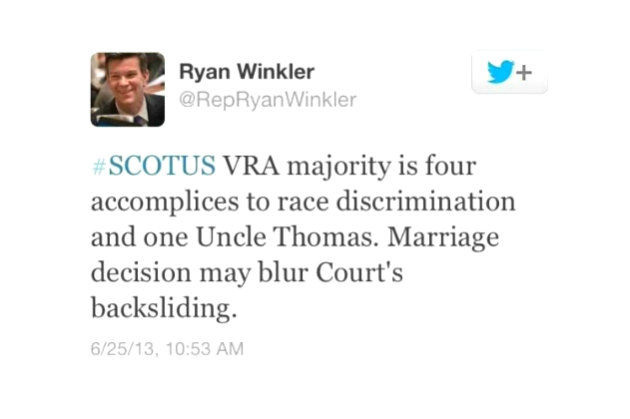
A Minnesota state representative has apologized for a tweet in which he referred to black Supreme Court Justice Clarence Thomas as "Uncle Thomas."

Shortly after the Supreme Court's 5-4 decision striking down a key provision of the Voting Rights Act was announced Tuesday, Ryan Winkler, a Democratic lawmaker from Minnesota's 46th district, tweeted:

#SCOTUS VRA majority is four accomplices to race discrimination and one Uncle Thomas.

The tweet was subsequently deleted, and Winkler issued several apologies on Twitter, claiming he wasn't aware he had used a racial epithet.

"I did not understand 'Uncle Tom' as a racist term, and there seems to be some debate about it," Winkler wrote in response to a tweet linking to a blog post about his offensive message.

But there does not appear to be much debate. "Uncle Tom" refers to the faithful slave in Harriet Beecher Stowe's "Uncle Tom's Cabin," and is defined by Merriam-Webster as "a black who is overeager to win the approval of whites." Winkler's tweet suggested Thomas voted to gain the approval of his Caucasian counterparts.

"I didn't think it was offensive to suggest that Justice Thomas should be even more concerned about racial discrimination than colleagues," Winkler wrote on Twitter. "But if such a suggestion is offensive, I apologize."

According to Winkler's biography on the state House website, he earned a bachelor's degree in history at Harvard. He was elected in 2006.

In a statement posted to the site, Winkler added:

I was very disappointed today in the Supreme Court decision to roll back key provisions of the Voting Rights Act because I believe the Voting Rights Act is one of the most important steps our nation has taken to eliminate racial discrimination.

In expressing that disappointment on twitter, I hastily used a loaded term that is offensive to many. My words were inappropriate and I apologize. The implications of this Supreme Court decision are serious for our state and country and I regret that my comments have distracted from the serious dialogue we must have going forward to ensure racial discrimination has no place in our election system.

Winkler told Minnesota's Star Tribune he simply thought the epithet meant "turncoat."

"I intended to point out the fact that Justice Thomas had turned his back on African-American civil rights," Winkler said. "I did not intend it as a racially derogatory term and I probably reacted too hastily in using a word that is very loaded."

[Hat tip: Daily Intelligencer/City Pages]

Source: http://news.yahoo.com/blogs/news/clarence-thomas-uncle-tom-tweet-202207921.html

ncaa basketball scores Harry Reems ncaa basketball ncaa tournament schedule March Madness Live Google Keep ncaa scores

Why We Forgive Misspelled Emails if They're 'Sent From My iPhone'

Soon after Apple's iPhone went on sale six years ago this week, you probably started spotting hastily-written emails appended by the words "Sent from my iPhone." And then, a bit later, you spotted a lot more. Of course, the iPhone was not the first email-enabled smartphone to attach such a message to outgoing emails. So did various Treo handsets (remember those?) and BlackBerry phones, pre- and post-iPhone. The iPhone's instant success, and its default signature, simply made the practice far more prevalent. Alongside this trend, a different but related one emerged: the iPhone's stock signature, at first deemed a louche emblem of status, became a built-in forgiveness clause.?Please don't judge me for any typos or spelling errors, "Sent from my iPhone"?suggested.?I am very busy. That's according to a chart published on Tuesday by the author?Clive Thompson, who drew data from a 2012 Stanford study on the perceived credibility of misspelled emails sent with (and?without) a "Sent from my iPhone" signature:

RELATED: A Smartphone Map of Our Nation

RELATED: How Long People Waited to Be First in Line to Buy Apple Products

Thompson comments on the findings of the study, which asked a group of Stanford students to assess the credibility of emails, some of which had the signature, others of which did not:

When the message had correct spelling, grammar and punctuation, the sender was rated as being very credible ? and there was little difference between whether the email seemed to have been composed on a computer or a phone. But when the message had errors in it, things changed: Students attributed higher credibility to the person who?d written the lousy message on a phone.

For these results, Thompson credits "linguistic code-switching" ? whereby people speak differently among friends, family, and coworkers ? and theorizes that the prevalence of AutoCorrect software has, paradoxically, made misplaced words and punctuation more acceptable in digital communication. (But no less funny.)

RELATED: It's All Fun and Games Until Someone's iPhone Blows Up

Indeed, the sociological implications of email signatures go fairly deep, according to others who have studied the subject. In 2006, for example, the technologist Michael Silberman argued that the signature suggested a particular affection for the email's recipient. "If we're responding to you from our phone or BlackBerry, it generally means that we're going out of our way to respond under some inconvenient circumstances," he wrote. "It's not like we took our phone to the cafe to catch up on email. We're risking our life to respond to you while walking, eating, drinking, traveling, or juggling. You can thank us later."

RELATED: The Reality of Augmented Reality

Photo by Chukcha via Shutterstock

Source: http://news.yahoo.com/why-forgive-misspelled-emails-theyre-sent-iphone-214422087.html

Malware Monday First Row Sports American flag Happy 4th of July 4th Of July Desserts fireworks fireworks